
Test-series dates explained
A test series supplies a recurrence range, a frequency and the duration of each occurrence. Its From/To dates do not mean that every date in the range necessarily has an occurrence: frequency, weekdays, holidays, weekends and exceptions also matter.
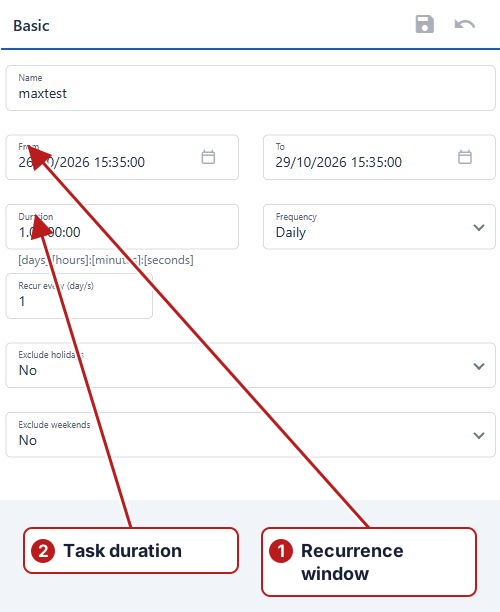
Range versus duration
From establishes the series start; To bounds the series. Duration determines how long an occurrence lasts. The generated occurrence end is limited by the series end. An occurrence close to To can therefore be shorter than the normal duration.
Consecutive series
For daily midnight starts, a series from 3 August 00:00 to 10 August 00:00 generates starts on 3–9 August. A following series from 10 August 00:00 to 17 August 00:00 generates starts on 10–16 August. The adjoining boundary is shared, and a start equal to To is outside the earlier series.
| Series | From | To | Daily starts |
|---|---|---|---|
| First week | 3 Aug 00:00 | 10 Aug 00:00 | 3–9 Aug |
| Following week | 10 Aug 00:00 | 17 Aug 00:00 | 10–16 Aug |
A full financial year
For daily midnight starts covering 1 July through 30 June, use 1 July 00:00 of the first year to 1 July 00:00 of the next year. Set weekday and holiday rules according to the actual requirements. Review the generated starts around both boundaries.
Change an existing range
Submitted work can make a series read-only or lock its occurrences. To continue a completed period, define an appropriate follow-on series rather than assuming old results can be reshaped. Shortening To can remove eligible unsubmitted occurrences starting outside the new range, so inspect future work before saving the change.
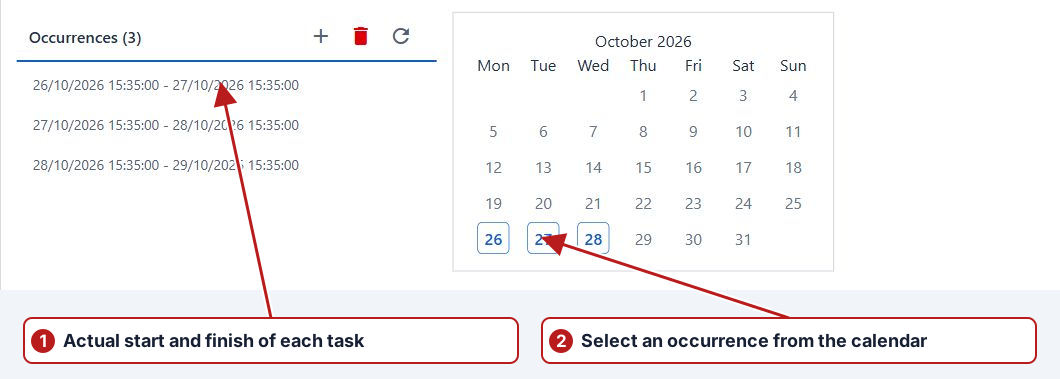
Calculation periods
For an aggregate, its calculated task must cover the intended source tasks. Set a duration that matches the reporting period; recurrence determines when new periods start.